
 Become a volunteer
The Queen’s Guide Award
My name is Kimberley Clarke and I am the Queen’s Guide Award Coordinator for Girlguiding Northamptonshire.
What is the Queen’s Guide Award? Who can complete it?
The Queen’s Guide Award is the highest award that can be undertaken in Girlguiding. To start it, you must be between the ages of 16 -25 and you have three years to complete the award or before your 26 birthday – whichever is sooner. You decide on your own mentor to support you through the award, normally someone you know in Girlguiding.
Taking a Pause
As a result of the current circumstances (COVID-19 pandemic) which is out of everyone’s control, extensions can be granted to those that need them, which would mean that you could still complete the award after your originally planned completion date. For those starting the award, those elements that cannot be completed in this current environment can be paused and a new suitable date can be agreed with your Queen’s Guide Award Advisor once Girlguiding activities resume. A pause will not affect or count as part of your 12-month break. You can take a break separately if you wish to. If you have any concerns, please contact your County Queen’s Guide Award Advisor.
For the Queen’s Guide, there are five different areas that you complete. These are:
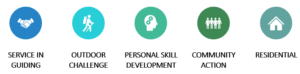
All the Sections and Elements can be found in the Queen’s Guide Resource here.
This is the page where you see the updates and changes to the Queen’s Guide Award over lockdown here.
I will go through each element in each section.
Service in Guiding
This clause is your opportunity to make a personal contribution to Guiding.
Element 1
Carry out practical guiding service for a period of 60 hours. At least 20 of these hours should be dedicated to one particular activity or project. Some ideas include:
-
40 hours could be unit meetings as a leader (this could include virtual meetings as well as physical meetings) and 20 hours could be completing your young leader/adult leadership qualification
-
Volunteering as an adviser, trainer or commissioner
-
Working as a member of a service team at a camp
-
Taking part in a GOLD project
-
Volunteering at Girlguiding County Shops
-
Volunteering at a campsite or activity centre
-
Running Peer Education sessions.
Things that could be done in lockdown for this element could be remote volunteering, doing unit administration, create social media content, programme recording, etc.
At the moment, for element one: you don’t have to spend 20 hours on one specific project, but just 60 hours of general guiding service. This is until 31 December 2020, but this may be extended.
Element 2
Attend a residential guiding event and accept a responsibility that is new to you or that furthers your guiding experience. The responsibility should be appropriate to your capabilities and the event should last for at least two days and two nights
Whilst you can’t go to any events, there might be some planning or preparation you can do. Here are a few suggestions of things that you might undertake. But remember you can pause this element if you need to during this time.

At the moment, with element two: you can do this through a virtual residential or camp. It only needs to last one night until 31 December 2020, but this may be extended.
Element 3
Take an active part in the planning of an event that involves the participation of at least two units. This element will require you to work alongside others and develop teamwork skills. It will also require you to prepare well and communicate with other members of your working group. Here are a few suggestions of things that you might use for this element: –
-
Rainbow Fun Day
-
Brownie Adventure Day
-
Guide Activity Day
-
Division campfire
-
World Thinking Day celebration
Alternatively, speak to your mentor or Queen’s Guide Award Advisor to agree a different activity. Please remember that, again, this element can be paused.
At the moment with element three you could organise a different kind of event. Why not set up a scavenger hunt trail in your local area, and invite girls from two different units to take part with their families? Your event doesn’t have to be one that girls come to in person, but could be one that they can take part in over a period of time until 31 December 2020, but this may be extended.
Element 4
Take an active part in developing an area of Girlguiding. Track progress and give feedback on your experiences to a local unit. This element is an opportunity to get involved in guiding projects and have an impact at a county level or above. It’s your chance to contribute to the development of Girlguiding. You could get involved with:
-
Task and finishing group
-
Working groups
-
Committees
-
Volunteer adviser/coordinator roles
Here are some ideas of things that you might get involved in for this element:
-
Joining your Country or Region’s council or forum
-
Joining the British Youth Council delegation
-
Volunteering for a working group working on a UK-wide event
-
Visiting and taking part in a WAGGGS seminar (Juliette Low Seminar for example)
-
Joining the national SSAGO executive committee
-
Join the WAGGGS Volunteer Resource Pool – link – https://www.girlguiding.org.uk/what-we-do/events-and-opportunities/event-and-opportunity-finder/join-the-wagggs-volunteer-resource-pool/
Again, this element could be paused.
Element four, depending on what you’ve chosen, see what you can keep doing. Meet as a task and finish group digitally, or spend some time doing a bit of research on your chosen area.
Outdoor Challenge
Develop leadership and teamwork skills in an outdoor environment.
Element 1
Prepare for your expedition or exploration by leading a residential for two or more nights. This is your chance to develop your leadership skills and take charge of a residential. Depending on your current role in Girlguiding and your age, this can be done either with peers or young members.

During Lockdown you could be planning menus, aims, routes or research for trips ready for when you can go on them. This element can be paused during lockdown.
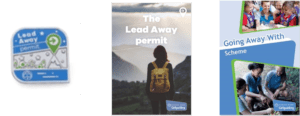
You can get a lot of support from your County regarding undertaking the Going Away License or your Lead Away Permit. Just contact your Residential Advisor. There are also books available from your local guide shop which can help you.
At the moment for element one, if you’re doing an 18-30 residential, you can take a minimum group size of three, including yourself, and only go for one night. However please check with your county coordinator if this is allowed in your area. This is until December 2020 but may be extended.
Element 2
Participate in an exploration or expedition to last four days (three nights) accompanied by your peers. You can pause this element during lockdown.
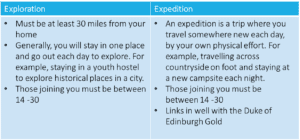
For the moment in regard to element two: your expedition or exploration can happen within 30 miles of where you live. You’ll need to find a new way of exploring it. You can also plan an expedition/exploration in your local area where everyone returns home to sleep, but still participates in all other aspects. You may do your element 2 before element 1. This is until December 2020 but could be extended.
Personal Skill
Develop a personal interest or hobby.
For a minimum of 60 hours over 12 months, take an existing skill to a new personal level or start a new skill and develop it.
At the moment you can practice more than one personal skill over the course of 12 months. Each skill you will still need a goal, and they collectively last for the full 12 months consecutively. You’ll need an assessor for each skill you do. This is until 31 December 2020 but maybe extended.
Depending on what you’ve chosen as your skill, you can keep this going at home. If you’ve picked something that you can’t do, have a think about ways you can keep it going. If it was playing a team sport, or coaching, can you continue this in a different way by learning online?
In lockdown you may be able to do this element at home such as cooking, coding, crafting etc.
Community Action
Encourage active participation in the world in which we live. This is where you will choose a topic that you would like to do both a research and a practical element for. You have got 12 months to do element 1 (your chosen topic practically) and element 2 (the research part) and finish with a presentation about what you have done. The presentation could be to your unit or an interested party.
Element 1
Your chosen topic must enable you to become involved practically at a local or UK-wide level and allow you to undertake further research to deepen your understanding of the topic at a UK-wide and international level.
Some examples you could look at:
-
Action for Change
-
Body Image affected by social media
-
Recycling in your local area
-
Flooding
-
Women in Science, Technology, Engineers, Mathematics Roles
-
Mental Health in young people or adults
-
Women’s participation in sport
-
Cooking skills of students
During Lockdown, you could contact a charity/community organisation to see if you can help remotely and start your research project.
Element 2
At the end of your 12 months, you should present the findings of your research project and an evaluation of the practical project to those who have been involved or to another group of people to be agreed with your mentor.
Some examples could be:
-
Interest groups
-
Another unit
-
Commissioners/ Coordinators
-
Council or Local government
Research project: use this time to research from the comfort of your own home!
Practical project: depending on your chosen topic, there may still be ways you can support your cause practically. If it’s safe to do so, you can volunteer as an NHS Responder. Or you might be able to volunteer remotely – it could be ringing isolated people as a befriender.
At the moment you can support two or more causes over the course of the 12 months. For each cause, you must still do a theory and practical element, find assessors and present back to units. This is until 31 December 2020 but maybe extended.
Residential
This is an opportunity for you to go away from home, to participate in a new experience, to make new friends and learn about each other and to work together as a team. The residential experience clause has no limits and provides unlimited opportunities. The basic requirements are that you take part in a residential event for a minimum of two nights and three days, and attend an event where the majority of participants are unknown to you (this may sound daunting at first, however it’s much easier than you think). This element can be paused during lockdown.
As you can’t go on a residential right now, it’s nice to plan something to look forward to. Have a think about what you could do once you can.
At the moment you can count a residential you did in the 12 months prior to starting your award. You can also use a residential where you go home to sleep, as long you spend the days doing activities. This is until 31 December 2020 but maybe extended.

